Making Government/ Administration and Teacher Accountable
Let’s talk about the Media Literacy a bit more here though I have described the process to become one in the above two sections. Media literacy refers to the analyzing skills of media messages which can distinguish between journalism and other types of information, news and opinions, assumption and verification, assertion and inference, and media biases and audience biases. Precisely talking about a content, a media literate must ask questions about who created the message, how the message is distributed, how you and other people react to it, what is represented in the message and what is the purpose behind that message. Now who will explain that to the school and college students.
A big gap remains in our education system even after we boast about the introduction of a new education policy in this country. The NEP 2020 surely talks about leveraging the use of technology and transforming it as a center of education for the students.
But from the pedagogical development of students, why has the government not considered media literacy program as a curriculum in schools and colleges.
I would try to draw a global picture of media literacy program which is made mandatory in school curriculums in some Nordic countries like Finland, Norway, Sweden, etc. and in some European countries like Denmark, Estonia, Ireland, etc. In fact, inspired by the initiatives of these countries, even some states in the USA recently legislated laws mandating information literacy training programs for students of K-12 i.e., Kindergarten through grade 12. Finland had introduced the media literacy program way back in 2014 and mandated it for students of all ages aiming at a pedagogy that develops critical thinking in young people and teach them to push back against the ‘fake news’. The Finnish model of media literacy program in schools is placed at the top among the European Media Literacy index.
Talking about the United States, despite several efforts were put for media literacy related education at university level, Illinois felt the need to teach the same to the younger students and became the first state to mandate media literacy education in public high schools in 2021. In Jan 2023, New Jersey passed a law mandating information literacy for students of K-12. The objective of this law as stated by the Republican senator – Mike Testa is to increase the ability of students to –
“weigh the flood of news, opinion, and social media they are exposed to both online and off” and “not about teaching kids that any specific idea is true or false, rather about helping them learn how to research, evaluate, and understand the information they are presented for themselves”
Governor Murphy signs bill requiring media literacy lessons in schools – New Jersey Monitor
So, the moment I look at the NEP 2020, I feel disappointed at the lack of value being given for the pedagogical development of curriculums. The government is encouraging the use of media in education without considering the importance of media education. Forget about its importance for primary to high school students – if you try to find out its possibility in college and university education at least in Assam, it is pathetic. There are hardly five government colleges in Assam which offers a bachelor’s degree in mass communication, media, or journalism. And despite that, thousands of NET and JRF qualified journalism students are waiting to apply for Assistant Professor job. Most of them are interdisciplinary candidates, completed their bachelors, or diploma and masters from private universities or colleges as five public universities in Assam offer only full-time master’s program in campus in the field of mass communication and journalism.
The point I want to make here is how even in the college level, the government is struggling to introduce media education course and at the same time severely failed to utilize the qualified candidates of media education background. This indicates uncertainty for media educated students who in a large number waits for opportunities in academia than the industry. In such a scenario, I wonder why the government lacks the thinking of utilizing this huge resource of qualified candidates by allowing them to teach media literacy as an interdisciplinary subject in both school and college level.
There is no need to introduce a new department of media education or allocate separate funding for the same in colleges, the easiest thing the government can do is to introduce a curriculum on media literacy allied with other departments in colleges or even in schools.
Suppose a school employs two or three English teacher – one can be recruited from media literacy background.
I am not telling this out of the blue – I recently mentored a high school teacher of English on media literacy in US and I found that along with the English studies, she is also teaching media literacy as a part of the English curriculum. Then I realized how media literacy education can be infused into the curriculums of more than one subject – like in English, Political Science, Education, Economics, etc. in colleges and English and Social Science in schools. The government, especially the ministry of education and the ministry of information and broadcasting must collaborate to both legislate a law mandating media literacy education for school students in India and develop a media education-based curriculum in colleges in consultation with the specialists from academia.
School teachers, professors from colleges and universities must come out and collaborate to experiment a media literacy program in their core courses for a year or two. They can modify their syllabus and conduct an experiment program sanctioned by the authority upon the students who must get a certification at the end. Political science teachers can organize seminars or workshops on how to literate people about the political information on social media or how people can get rid of the polarizing political messages or educate about the use of media in the process of political communication. They must provide a platform to students for decoding the controversial statements made by politicians mostly in social media from time to time.
It is important at a time when there has been a total of 500 per cent increase in hate speeches by politicians in India since 2014 in comparison to the preceding government. And such communications of hatred as discussed earlier demands proper study from the perspective of media literacy so that the society is not entirely saturated into such information which brings division. Education teachers can organize talks at the use of teaching learning materials in education not only for the purpose of pedagogical development of teaching and learning but also as a medium of literacy. English teachers, both language and literature can focus into the use of text by the younger generations today, especially in the popular media like films, music, social media, etc. Librarians can immensely help in developing information hub that alleviates the impact of misinformation or fake news. Library science as a discipline in colleges and schools can collaborate with media educators to develop an allied course for bringing literacy in information. All in all, teachers are the primary investigators of media literacy education in campuses. Media literacy is completely based upon their approach towards education in this changing age of digitalization today.
By administration, I would like to see the civil servants, civil societies, non-government organizations, etc. arranging or framing the public need policies through the prism of media literacy. If there is a local court in the region and the proceedings are registered online – it must be the responsibility of district administration or any civil society to train people about the use of media. More than the use of media which is technical in nature – the administration can at least organize a summer camp or awareness campaign to give the non-technical knowledge like how to detect false information or fake news. It is generally seen that youths become the easy targets of misinformation as some miscreants organizing small political rallies and protests based on fake news can easily make them the scapegoats. The district administration with the help of some non-government organizations can provide weekly training programs to the youths of the region so that they learn to filter the useful information from the misleading ones.
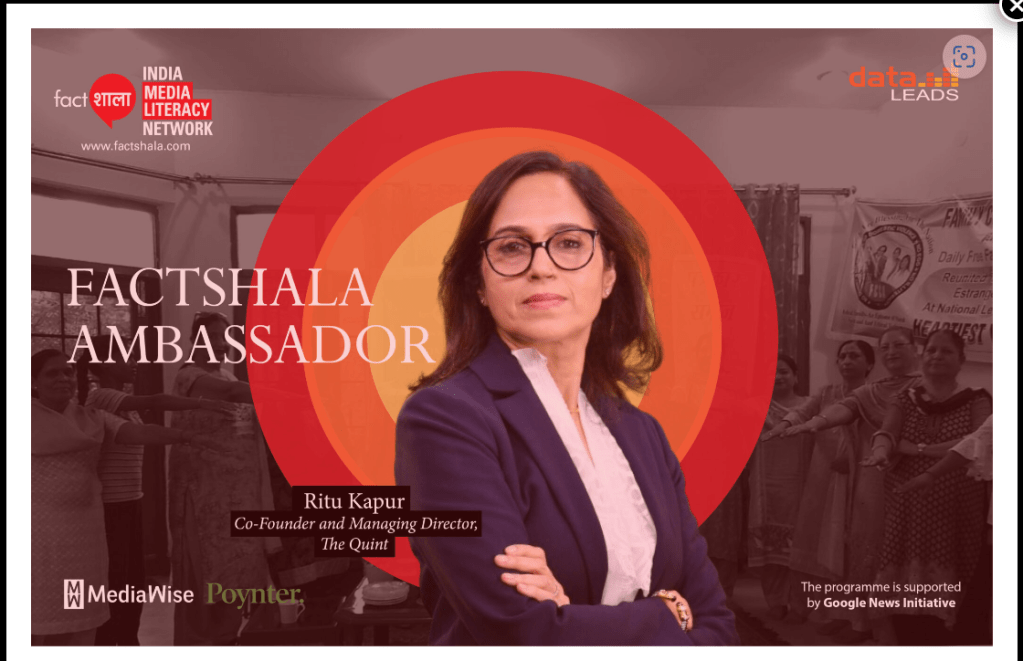
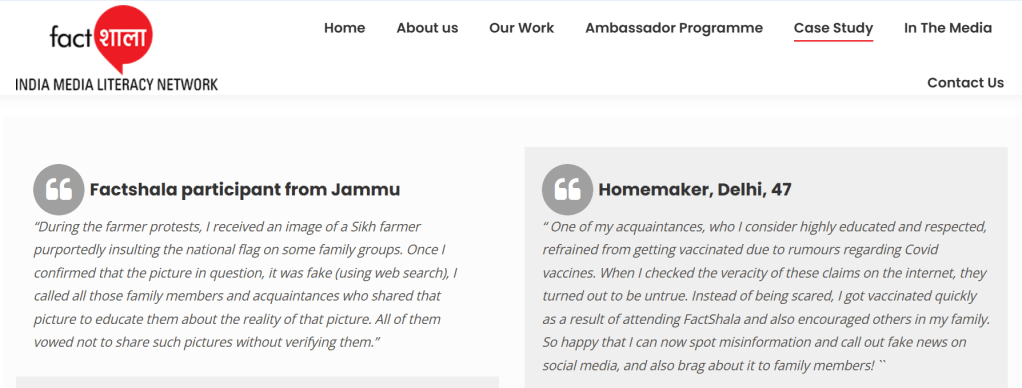
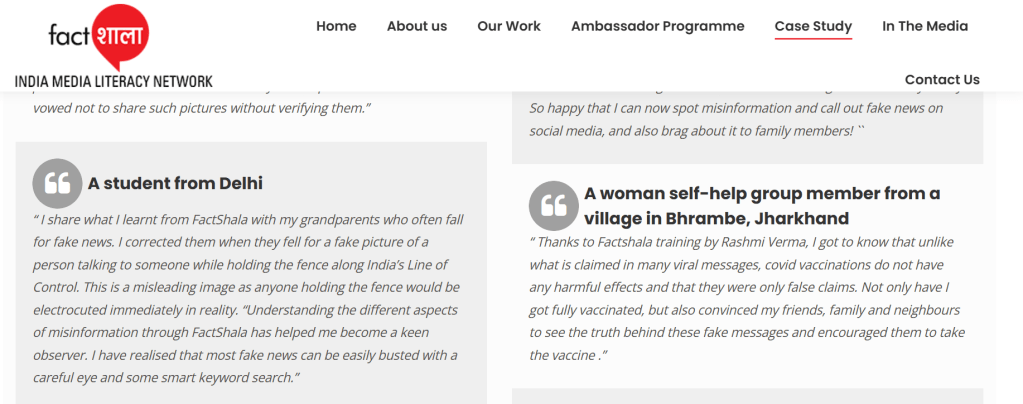
There have also emerged several news literacy organizations in western countries, whereas in India there are only few of them – one popular network is FactShala launched in 2020. I would appeal the administrations, NGOs or even the educational institutions to collaborate with such networks to empower the students/ adults and foster their critical thinking.
 Telling The Hate Tale
Leave a comment